Final words from Franco
Notice the gesture of the crowd at the end. A completely natural, almost unconscious salute, a reaching towards the beloved leader who, decades before, saved their nation from nihilistic slaughterhouse of communism.
Notice the gesture of the crowd at the end. A completely natural, almost unconscious salute, a reaching towards the beloved leader who, decades before, saved their nation from nihilistic slaughterhouse of communism.
As of 2024, the United States is home to roughly 50 million foreign-born legal citizens, or 15% of the total population. Their children, second generation Americans, number over 20 million. Combined, their numbers comprise 30% of the current US population.
The official number of illegal immigrants living in the US sits at 14 million, but unofficial estimates triple that number, or 42 million. Roughly 300,000 babies are born annually to illegal immigrant families each year, or 9% of total annual US births.
Over the past 4 decades, the US has accepted 3.5 million refugees from various Third World nations. Refugee status allows them to also sponsor family members for resettlement.
Each year, the US issues roughly 600,000 immigrant visas via consulates and embassies overseas, as a path to permanent residency in the US. Overall, 1.4 million immigrants become “lawful permanent residents” in the United States annually. Over the past four decades, 38 million people have acquired permanent residency in the US. Of these 38 million, 24 million more of their family members have been sponsored and resettled here. Roughly 80% of all green cards are issued to immigrants from the Third World.
20 million have achieved full US citizenship over the past 40 years, and have sponsored 25 million family members.
The birthrate among naturalized us citizens sits at 2.19, compared to 1.73 among native-born citizens.
According to Grok, 88% of net job growth has gone to foreign-born workers in the United States over the past five years.
Something that goes completely unacknowledged by pretty much everyone is the existence of vast white slums that lie on the outskirts of every small town in Middle America. Growing up within 30 minutes’ driving distance of several, it always seemed strange that these were never spoken of, almost as if no one even noticed. But they’re there, block after block of impoverished, filthy men, women, and children, all white, and all living in deplorable Third World conditions. They’re harmless, mostly, and seem at peace with the station in life they’ve found themselves in. It’s strange, bordering on the surreal, to drive through them today, and see that not only are they still there, but they’ve expanded, become more densely populated, and fallen further in decrepitude. These people are far past hopelessness, the despair hanging like a poisoned, invisible fog. They’re not hopeless, because hope has never entered their mind. Generation upon generation have lived this way. How long has this state of affairs existed? More importantly, why hasn’t something, anything, been done to solve this utterly unaddressed crisis? For all the money sent overseas, Uncle Sam could spare a few to help what appear to be a people you’d normally see working stable jobs, and living tolerable lives. You can see the intelligence in their faces and hear it in their voices, and envision the squandered potential. That may be the worst part of it. They aren’t low IQ, although they may live hand-to-mouth on EBT, and be addicted to meth, alcohol, and the many other vices common among those who need it just to get through the day. frequent visits to small town Oklahoma feel more like expeditions into forgotten sloughs of despond. I have a bad feeling that they will always be there, that nothing will be done, and that it will only get worse.
This
After killing a Russian soldier, a Ukrainian soldier used the dead man’s phone to call his wife, tell her that her husband had been killed, and mock her over the phone in March 2022. https://t.co/5N7uh0Iw1Z
— WarRoom Archives (@WarRoomArchives) October 16, 2026
As children and as we grow, history is presented to our developing minds as endlessly banal and soporific, almost as if on purpose. As if the teaching of it is specifically designed to induce tears of boredom, and a lifelong hatred of the subject. Everyone, almost to a person, appears to be conditioned to never look for more than a moment at historical anomalies. The strange fact that Corinthian columns, Second Empire and Beaux Arts architectural design, and enormous Gothic arches exist throughout the world, as if built around the same time period, and with the same horse-and-buggy tools that apparently were used to construct the colossal Gothic masterpieces of Medieval Europe, never enters our minds, having been successfully innoculated against historical curiosity.
Look at St. Louis, Missouri, before the intentional destruction of these masterpieces. You’d assume these had stood for 500 years if you didn’t realize it was 19th century America. Maybe you’d be correct.
Merchants Exchange

Old Four Courts (demolished):

Fullerton Building (demolished)

Basilica of St. Louis (still standing):

The Missouri Republican Building, demolished to make space for the St. Louis Arch:

Through the 1930s, over 400 similar buildings were demolished along the St. Louis riverfront, as part of a supposed riverfront revival, severing a physical link to an enshadowed past. What could have been the real reason for the deliberate destruction of such priceless works of art? Is it really possible to believe that these were built with the limited tools of the period?
America remains mired in permanent crisis, and has done so for years. We’re made to believe that we should accept it as just a normal state of affairs, that nothing can be done, and so the crises and their severity increase exponentially as the young pick up the tab to fund what has become a spectacle and gravy train for the old. The elderly oversee the parceling of the corpse of what was once America, and could have been something more idyllic, more enduring,
The children of the Greatest Generation seem to have absolutely no care about what comes after them, and so they’re going out in a narcissistic bloodbath of sour grapes, taking the nation with them.
Our leaders are old, the voters are old, every vote, every executive action, every legislative abomination benefits exclusively the elderly who hold our future in a white knuckle grip, at the expense of the young and the future. We must face soberly the question of what will the United States look like in 10, 20, or 30 years’ time. The Geriatric Class does not appear to care, and our current political system clearly is designed to only take into account their desires, and has apparently enacted a creeping self-destruct mechanism to ensure that the America that comes next will be one not worth saving. Is it worth saving? What form would salvation come in? Not democracy, not voting, not a “working through the current system”. We’ve tried it, and it’s brought us deep into Hell. Democracy is truly the god that failed, and yet the fallen idol is still worshipped, its religion still taught to the next generation of congregants. Its become a hollow religion, a suicide pact, and what is needed now is Reformation, an energetic apostasy, a Cursus Honorum. Honor, that archaic concept, does not exist among elected officials today. Professional con artists with the personality and depth of used car salesman oversee our rapid decline
We could look to the Old World, to the early Roman Republic, who held honor as a character trait worth acquiring, and make some attempt to impose it. But do we have the will? Would the values of the Old World thrive in what increasingly feels like a socio-political purgatory? Rome became an historical cautionary tale for future generations. America will follow, an example made by God of what not to do, a Divine punishment, when civilization is rebuilt. But will those who know better really go silently without so much as a complaint?
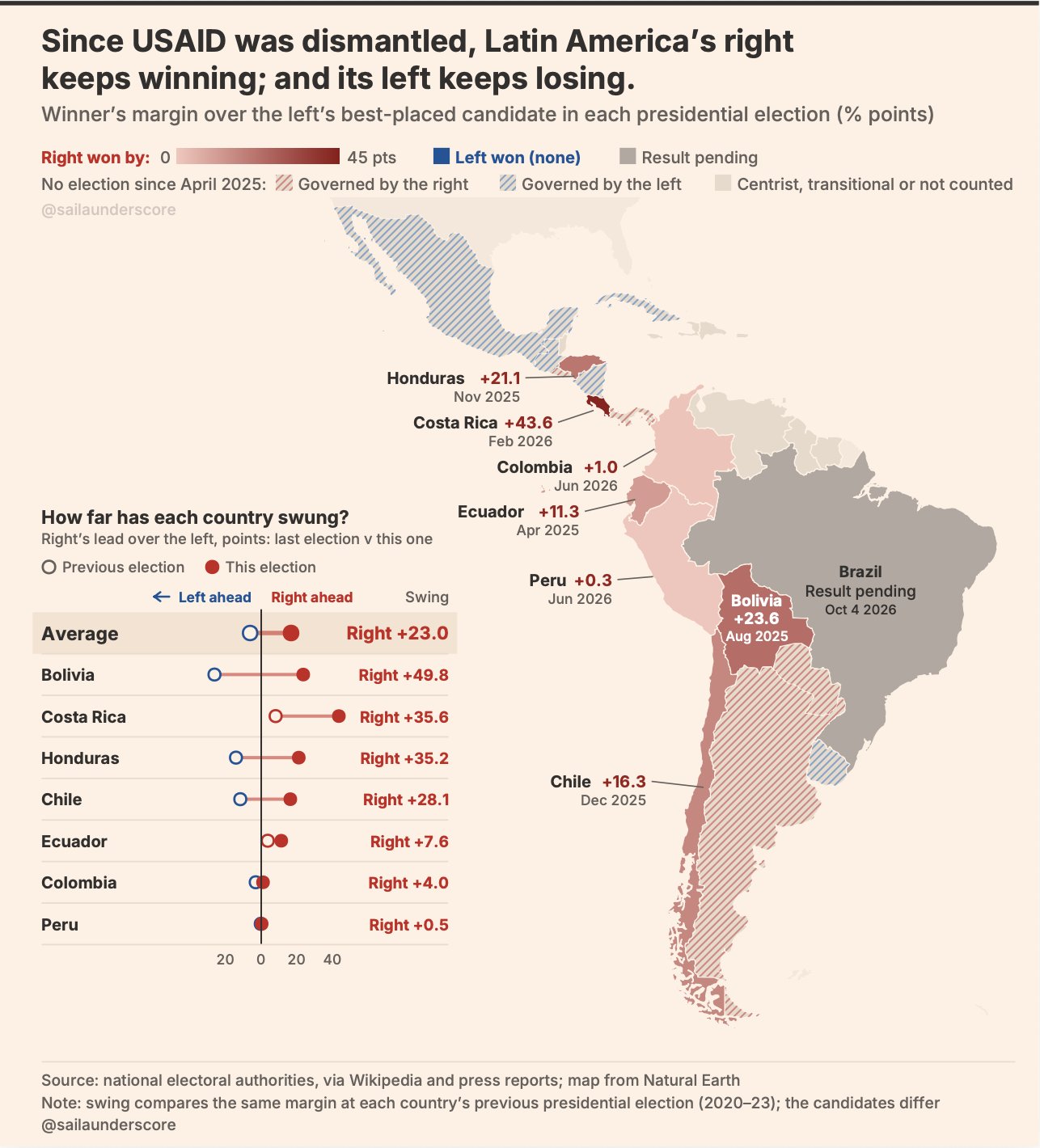
We see this astonishing data point and it does nothing more than confirm what we knew in our hearts. Civilization and its participants are right wing. They yearn for order, stability, and the swift, objective, forceful application of the Rule of Law. “Democracy”, and “voting”, leave a vulnerable back door for foreign artifice, astroturfed “color revolutions”, and orchestrated campaigns that inorganically sweep Leftism into power. If the US was this effective at propping up Leftist politics in South America, imagine what its doing on its home turf.
Honesty from everyone involved the day of Kirk’s assassination would have gone far to ease suspicions about what really happened. But instead they’ve been evasive about everything, telling white lies, and it looks like big lies, about what occurred, Brian Harpole the shadiest of them all. What he’s doing here might have been easily explained, and he could have done so, but he hasn’t. Why?
BREAKING: New Video surfaces of Brian Harpole turning something on/off that’s attached to Dan Floods side!
In that very moment, what was Brian Harpole so concerned about on Dan Floods waist? pic.twitter.com/iSeiTvgyUn
— FromConvict2Conservative (@YaakovRenewed) January 13, 2026
Has there ever been a cleaner and quicker draw-and-fire?
A man was shot this morning after allegedly attempting to rob a CCL holder at a gas station near 151st Street and Harlem Avenue in Orland Park, Illinois. pic.twitter.com/9qGVBmWzhl
— Goofies Of Chicago (@Chicago_Goofies) September 15, 2026
“Jesse is a friend, he’s establishing that” hahaha
People are really figuring out how depraved the boomers were.
Rick Springfield also admitted to killing a random Vietnamese guy when you toured there. True story pic.twitter.com/5FIcddejdy— Owen Benjamin 🐻 (@OwenBenjamin) September 15, 2026